
 English
 Spanish
June 24, 2026 – by Daniel Ortiz | Broker/Owner, Coldwell Banker SMART San Miguel de Allende
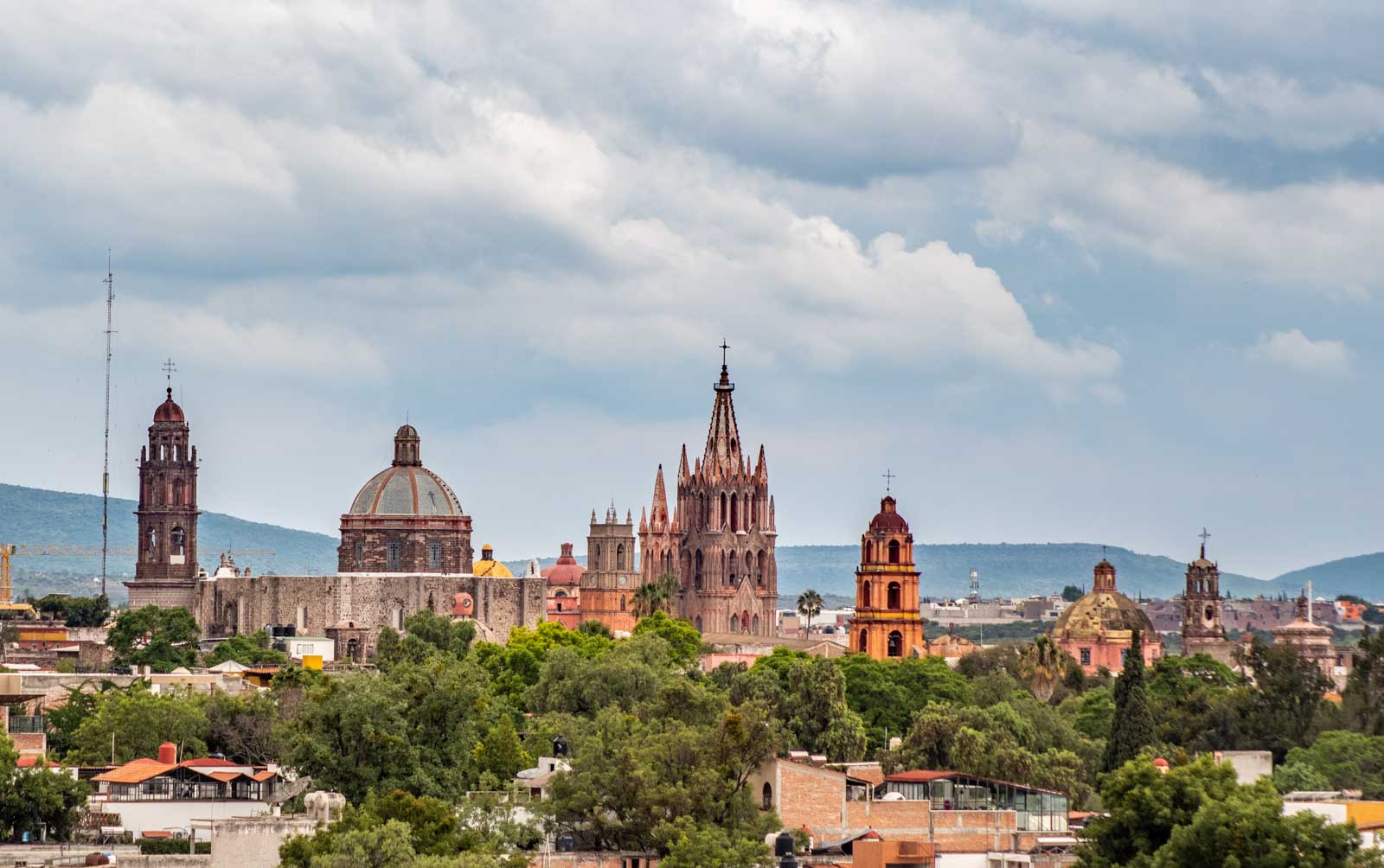
San Miguel Skyline – San Francisco Temple, The Parroquia and Las Monjas Temple
Two questions come up in nearly every serious buyer conversation I have — whether it’s someone flying in from Vancouver for a week of property tours, or a retired couple in Austin running the numbers before committing to a discovery trip. The first is some version of: “How much does it actually cost to close?” The second, especially for buyers who’ve done their homework, is: “Do I need a trust — a fideicomiso — to own property here?”
The internet has partial answers to both. What it rarely has is the combination of precise numbers from a real transaction and the nuanced, location-specific answer to the trust question. That’s what this article provides.
Note: The closing cost figures below come from an actual notary presupuesto issued in San Miguel de Allende in March 2026, on a transaction valued at $855,000 USD. They are real numbers from a real closing — not estimates, not industry averages.
Part 1: Do You Need a Fideicomiso to Buy in San Miguel de Allende?
The short answer is no — and understanding why matters enormously, both for your peace of mind and your closing cost calculation.
What is a Fideicomiso?
A fideicomiso is a bank trust created specifically to allow foreign nationals to hold real estate in Mexico’s “restricted zones” — areas within 50 kilometers of any coastline and 100 kilometers of any international land border. In these zones, the Mexican Constitution prohibits foreigners from holding direct title to property. The fideicomiso works around this by placing a Mexican bank as the nominal titleholder, while you — the foreign buyer — hold all beneficial rights: the right to use the property, rent it, improve it, sell it, and pass it on.
The fideicomiso is a solid legal structure, widely used and well-understood. If you are buying in Puerto Vallarta, Los Cabos, the Riviera Maya, or near the US border, you need one. But San Miguel de Allende is a different story entirely.
San Miguel de Allende Is Outside the Restricted Zone
San Miguel de Allende sits in the highlands of Guanajuato, approximately 270 kilometers from the nearest coastline and 450 kilometers from the nearest international land border. As a foreign national purchasing property in San Miguel, you are fully entitled to hold direct title in your own name. This is not a legal workaround or an exception — it is the straightforward application of Mexican law to a city that happens to be located well inside the unrestricted zone.
What this means practically: you are treated, for purposes of property ownership, exactly as a Mexican national would be. Your name goes directly on the deed. You hold full constitutional property rights with no annual trust fees, no 50-year renewal requirement, and no bank acting as an intermediary between you and your asset.
The SRE Permit: The One Federal Step That Remains
Even outside the restricted zone, foreign buyers must obtain a permit from the Secretaría de Relaciones Exteriores (SRE) before the deed can be issued in their name. This is a federal requirement that applies everywhere in Mexico, not just in coastal areas. The SRE permit formalizes your agreement to be treated as a Mexican national with respect to the property — meaning you waive the right to invoke your home government’s protection regarding the asset.
The SRE permit fee in San Miguel runs approximately $8,000 MXN (~$446 USD) per buyer and is included in your closing costs (see the table below). Your notary handles the application process as part of the closing. The process is well-established and rarely presents complications.
When Might a Fideicomiso Still Make Sense in SMA?
In rare situations, some buyers choose to hold San Miguel property in a fideicomiso even when it’s not required — typically for estate planning flexibility, to align ownership structure with their other Mexican assets held in trust, or on the advice of a cross-border tax attorney managing a complex family situation. This is a planning decision, not a legal necessity, and should be made with qualified legal and tax counsel, not defaulted into out of habit or misinformation.
The comparison table below summarizes the key differences between the two structures for your reference.
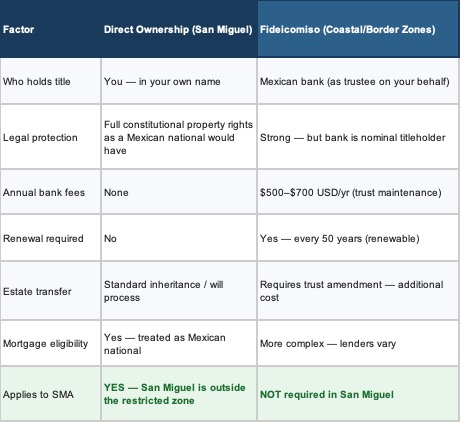
Bottom line: If you are buying in San Miguel de Allende, you own your property outright, in your name, with full legal title. No annual bank fees. No trust administration. No intermediary. This is one of the genuine structural advantages of investing in this city over coastal alternatives — and it is frequently misunderstood or simply not mentioned by agents who learned their craft in Cancún or Puerto Vallarta.
Part 2: What You Actually Pay at Closing — A Real Transaction, Line by Line
Most guides to buying property in Mexico tell you to budget “around 5%” for closing costs and leave it at that. After 20 years and over 1,800 closed transactions in this market, I can tell you that number is directionally correct but tells you almost nothing useful about where the money actually goes, why the amounts vary, and what to expect at different price points.
The table below is taken directly from a notary closing statement (presupuesto de gastos y honorarios) issued in San Miguel de Allende in March 2026, on a transaction with a purchase price of $855,000 USD. The exchange rate applied was $17.9218 MXN per dollar.
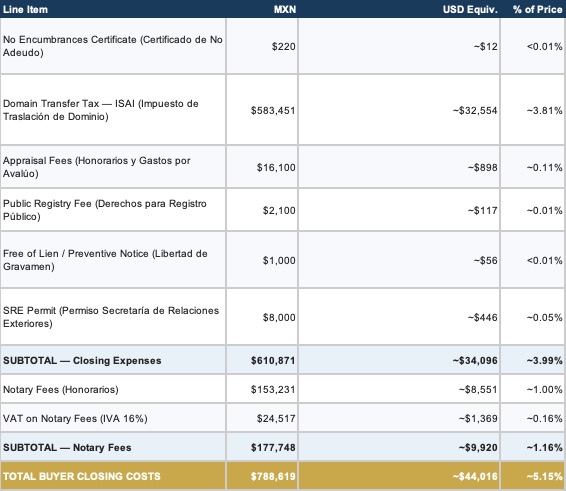
Source: Notaría Pública, San Miguel de Allende, Guanajuato. Presupuesto issued March 17, 2026. Exchange rate: $17.9218 MXN/USD. Figures are buyer’s closing costs only; seller’s costs (commission, capital gains) are separate.
What Each Line Item Means
Impuesto de Traslación de Dominio — Domain Transfer Tax
This is by far the largest single closing cost — roughly 73% of the total in the example above. It is a city-level acquisition tax levied on the higher of the purchase price or the fiscal appraised value (valor catastral). In San Miguel de Allende, the rate is approximately 3.8% of the transaction value. Note that if the seller purchased the property fewer than three years before this resale, a portion of their original acquisition tax can be transferred to the new buyer — which in practice can slightly decrease your domain transfer tax obligation. Your notary will flag this.
Notary Fees (Honorarios) + IVA
Notary fees in Mexico are regulated but not fixed — they are calculated as a percentage of the transaction value and vary modestly between notaries. In this transaction, notary fees came to approximately 1.0% of the purchase price, with 16% IVA (VAT) applied on top. The notary in Mexico is a very different figure than the “notary public” you know from the US or Canada: they are senior attorneys appointed by the state government, responsible for verifying title, calculating and remitting taxes, registering the deed, and providing legal advice to all parties. Their fee reflects that scope of responsibility.
Appraisal Fees (Avalúo)
A formal valuation is required as part of the closing process — the Domain Transfer Tax calculation depends on it. The appraisal is conducted by a certified valuator (perito valuador) and the fee scales with property value. On an $855,000 USD transaction, it ran approximately $898 USD — a relatively minor line item but a necessary one.
Public Registry Fee + Free of Lien Certificate
These are administrative fees for registering the deed in the Registro Público de la Propiedad and confirming the property carries no existing liens at the time of closing. They are modest amounts but legally essential — the registry inscription is what makes your ownership legally visible and enforceable against third parties.
SRE Permit
As described in Part 1, this is the federal permit from the Ministry of Foreign Affairs authorizing a foreign national to hold property in Mexico. Required everywhere in the country regardless of zone. The fee is fixed by the federal government and is currently $8,000 MXN per buyer — so a joint purchase by two buyers (e.g., spouses) will show $16,000 MXN on the notary statement.
How Closing Costs Scale at Other Price Points
The dominant variable is the Domain Transfer Tax or Adquisition Tax, which scales with purchase price. As a working guide for San Miguel buyers:
- $500,000 USD purchase → expect approximately $25,000–$28,000 USD in total buyer closing costs (~5.0–5.5%)
- $855,000 USD purchase → approximately $44,000–$46,000 USD (~5.1–5.4%)
- $1,500,000 USD purchase → approximately $77,000–$85,000 USD (~5.1–5.7%)
- $2,500,000 USD purchase → approximately $128,000–$145,000 USD (~5.1–5.8%)
One important planning note: closing costs in Mexico are the buyer’s responsibility. The seller pays commission and capital gains (ISR). Cash buyers should ensure closing cost funds are held separately from the purchase price deposit — your escrow or notary will specify exactly when and where each amount needs to be wired. Closing cost disbursements typically go to the notary’s operating account, separate from the purchase price escrow.
An Important Update: RFC Registration for All Buyers
Since May 2023, all buyers — Mexican nationals, permanent residents, and temporary residents alike — are required to have an active RFC (Registro Federal de Contribuyentes) issued by SAT (Servicio de Administración Tributaria, Mexico’s tax authority) in order to complete a property transfer. If you hold temporary or permanent residency in Mexico, confirm with your notary or a local accountant that your RFC is current and correctly registered before opening escrow. Obtaining one is straightforward but requires time — don’t leave it to the week of closing.
What Does the Seller Pay? (For Context)
Buyers sometimes ask about the seller’s side — particularly when negotiating and trying to understand total transaction economics. In brief:
- Real estate commission — typically paid by the seller per the listing agreement
- Capital gains tax (ISR por enajenación) — calculated on the net gain; various exemptions apply based on residency, how long the property was held as primary residence, and frequency of sales. An experienced notary and/or accountant can model this before you list.
- Any outstanding property taxes, HOA arrears, or utility balances — cleared at closing
These costs are entirely separate from the buyer’s closing cost table above and do not appear in the buyer’s presupuesto.
Sources & Further Reading
The claims in this article are grounded in Mexican federal and state law, direct transaction experience, and official government fee schedules. For readers who want to verify key facts or go deeper, the following official sources are recommended:
- SAT (Servicio de Administración Tributaria): RFC registration requirements for property buyers — sat.gob.mx— official portal for RFC registration and verification
- Secretaría de Relaciones Exteriores (SRE): SRE permit information for foreign property buyers — gob.mx/sre— federal Ministry of Foreign Affairs
- Constitución Política de los Estados Unidos Mexicanos: Constitutional provisions governing foreign property ownership (Article 27) — segob.gob.mx
- Registro Público de la Propiedad, Guanajuato: Property registry and deed registration — registropublico.guanajuato.gob.mx — state-level registry for Guanajuato
- Municipio de San Miguel de Allende: Tax administration and ISAI rate reference — sanmiguelallende.gob.mx — official city government portal
- Professional guidance: For cross-border tax planning (US/Canada to Mexico), consult a qualified international tax attorney. AMPI (Asociación Mexicana de Profesionales Inmobiliarios) maintains a national directory of licensed real estate professionals.

View to San Antonio Church
Frequently Asked Questions
The following questions reflect what serious buyers most commonly ask before and during the purchase process in San Miguel de Allende. Answers are based on current law and market practice as of 2026.
Do I need a fideicomiso (bank trust) to buy property in San Miguel de Allende?
No. San Miguel de Allende is located in the state of Guanajuato, well outside Mexico’s restricted zone. The restricted zone covers land within 50 kilometers of any coastline and 100 kilometers of any international land border. San Miguel sits approximately 270 km from the nearest coast and 450 km from the nearest border. As a foreign national, you are fully entitled to hold direct title in your own name — no bank trust required. Your name goes on the deed.
What is the total closing cost for a foreign buyer purchasing property in San Miguel de Allende?
Based on an actual notary closing statement from March 2026, total buyer closing costs on an $855,000 USD purchase came to approximately $44,016 USD — or 5.15% of the purchase price. The single largest item is the Domain Transfer Tax (ISAI) at roughly 3.8% of the transaction value. Notary fees add approximately 1.0%, with 16% IVA (VAT) applied on top of the notary’s fee. As a planning guide, budget 5.0%–5.5% for most transactions in the $500K–$2.5M range.
Who pays closing costs in a Mexican real estate transaction — buyer or seller?
Closing costs (acquisition tax, appraisal, notary fees, registry fees, SRE permit) are the buyer’s responsibility. The seller is responsible for real estate commission and capital gains tax (ISR por enajenación). These are entirely separate and do not appear on the buyer’s closing statement.
What is the ISAI and how is it calculated?
ISAI stands for Impuesto Sobre Adquisición de Inmuebles — commonly called the Domain Transfer Tax or acquisition tax. In San Miguel de Allende, it is levied at the municipal level and calculated on the higher of the negotiated purchase price or the fiscal appraised value (valor catastral). The rate is approximately 3.8% of the transaction value. On an $855,000 USD purchase, the ISAI came to approximately $32,554 USD, making it by far the largest single closing cost.
What is the SRE permit and how much does it cost?
The SRE permit (Permiso de la Secretaría de Relaciones Exteriores) is a federal requirement for all foreign nationals purchasing property anywhere in Mexico — including outside the restricted zone. It formalizes the buyer’s agreement to be treated as a Mexican national with respect to the property, waiving the right to invoke their home government’s diplomatic protection regarding the asset. The current fee is $8,000 MXN per buyer (approximately $446 USD). Your notary handles the application as part of the closing process.
Do I need an RFC (Mexican tax ID) to buy property in San Miguel de Allende?
Yes. Since May 2023, an active RFC (Registro Federal de Contribuyentes) issued by SAT — Mexico’s tax authority — is required for all buyers regardless of nationality or residency status. If you hold temporary or permanent Mexican residency, confirm your RFC is current before opening escrow. Obtaining one for the first time is straightforward but takes time — do not leave it to the week of closing.
Can I get a mortgage as a foreign buyer in San Miguel de Allende?
Because foreign buyers in San Miguel hold direct title (not through a fideicomiso), they are treated as Mexican nationals for mortgage eligibility purposes — which is a meaningful advantage over coastal markets where trust-held properties face additional lender complexity. That said, traditional Mexican bank mortgages for foreign nationals without permanent residency remain limited. Most buyers in the $500K–$3M+ range purchase cash or arrange financing through US/Canadian lenders using other assets as collateral. A qualified mortgage broker with cross-border experience can advise on current options.
What happens to my property when I die — how does inheritance work?
Because you hold direct title in San Miguel (not through a bank trust), your property transfers through standard inheritance processes — either through a Mexican will (testamento) or intestate succession under Mexican law. It is strongly advisable to have a Mexican will drafted by a notary to ensure your wishes are clearly documented and the transfer is efficient. If you also hold property in the US or Canada, a cross-border estate attorney should coordinate your Mexican will with your home-country estate plan to avoid conflicts.
What is the difference between the notary (notario) in Mexico and a notary public in the US or Canada?
They are entirely different roles. In Mexico, a notario público is a senior attorney appointed by the state government through a competitive selection process. They are legally responsible for verifying title, calculating and remitting taxes, drafting the deed, registering the property, and providing impartial legal advice to all parties in the transaction. Their stamp on a deed gives it full legal standing. The role is closer to a combination of a real estate attorney, title officer, and tax agent than to the notary public in the US or Canada, who simply witnesses signatures.
How do I verify a property has clean title in San Miguel de Allende?
Title verification is conducted through the Registro Público de la Propiedad de Guanajuato (the state property registry) and confirmed in the closing process by your notary. A proper closing includes a Certificado de No Adeudo (no outstanding tax debts), a Libertad de Gravamen (free of lien certificate), and a full title search tracing the property’s ownership history. Working with an experienced local broker and a reputable notary are the two most important decisions you can make to protect yourself on title. At Coldwell Banker SMART, we guide buyers through the due diligence process from offer through closing — with 1,800+ completed transactions in this market, title issues rarely surprise us.
About the Author
Daniel Ortiz is the Broker/Owner of Coldwell Banker SMART in San Miguel de Allende — the #1 Coldwell Banker office in Mexico. With over 20 years of experience and more than 1,800 closed transactions in this market, Daniel holds the CB Global Luxury Ambassador designation and is an active member of the International Luxury Alliance (ILA). He and his team specialize in serving high-net-worth US and Canadian buyers navigating the San Miguel real estate market at the $500,000–$5,000,000+ level.
Coldwell Banker SMART San Miguel de Allende
Nemesio Diez 8A, Centro, San Miguel de Allende, Guanajuato, México
sanmigueldeallende.realestate · @sanmigueldeallendehomes
LEGAL DISCLAIMER: This article is provided for general informational purposes only and does not constitute legal, tax, or financial advice. Closing costs, tax rates, and regulatory requirements are subject to change. Consult a qualified Mexican notary and/or cross-border tax attorney for advice specific to your transaction